
What OpenJarvis is
OpenJarvis is an open-source framework (Apache 2.0 license) for building personal AI agents that run on your own machine, not in the cloud. Its tagline says it well: "Personal AI, on personal devices." The cloud stops being the default and becomes optional.
It was built at Stanford, across the Hazy Research and Scaling Intelligence labs, and its 1.0 release landed in 2026 with native support for Ollama. The bet is simple: flip today's equation, where most "personal" AI actually depends on someone else's servers.
The idea: intelligence per watt
OpenJarvis grows out of a Stanford study called Intelligence Per Watt. The key finding is blunt: local models and local accelerators already accurately handle 88.7% of single-turn chat and reasoning queries, and at interactive latencies. On top of that, intelligence efficiency improved 5.3× between 2023 and 2025.
The practical consequence is direct: for most everyday tasks you no longer need to send your data to a third-party server or pay per token. It's the natural software companion for the local AI hardware I already covered with the DGX Spark.
The five building blocks
The framework is assembled from five composable primitives. That separation is what lets you swap a model or an inference engine without rewriting your agent.
| Component | What it does |
|---|---|
| Intelligence | Local model selection and catalog. |
| Engine | Inference runtimes (Ollama, vLLM, SGLang, llama.cpp) with hardware auto-detection. |
| Agents | Eight agent types with multi-step reasoning and tool use. |
| Tools & Memory | Web search, code execution, files, persistent memory and MCP servers. |
| Learning | Automatic improvement from local usage traces. |
It runs on almost any accelerator (Apple Silicon, NVIDIA, AMD, NPUs or CPU) and exposes an OpenAI-compatible API. In practice, any app that already speaks that format can point at your machine instead of the cloud.
Agents and skills
It ships eight ready-to-use agents across three execution modes: on-demand, scheduled and continuous. Among them: a morning digest with audio, deep research with citations, a continuous monitor with memory, an orchestrator that picks tools on its own, and ReAct, CodeAct and simple-chat agents.
Skills are tools that agents discover and invoke on their own when needed. You can import them from Hermes Agent (around 150 skills), OpenClaw (about 13,700 community skills) or any GitHub repo that follows the agentskills.io standard.
The value isn't one more chatbot: it's running agents with memory and tools on your own hardware, without your data ever leaving home.
How you install it
There are native desktop installers (built with Tauri) for macOS (universal DMG, Apple Silicon and Intel), Windows 10+ (EXE) and Linux (DEB, RPM and AppImage).
What you need
- Python 3.10 to 3.13 and Node.js 18+
- Ollama (or a compatible inference engine)
- A quickstart script that installs dependencies, Ollama and a starter model in about 3 minutes
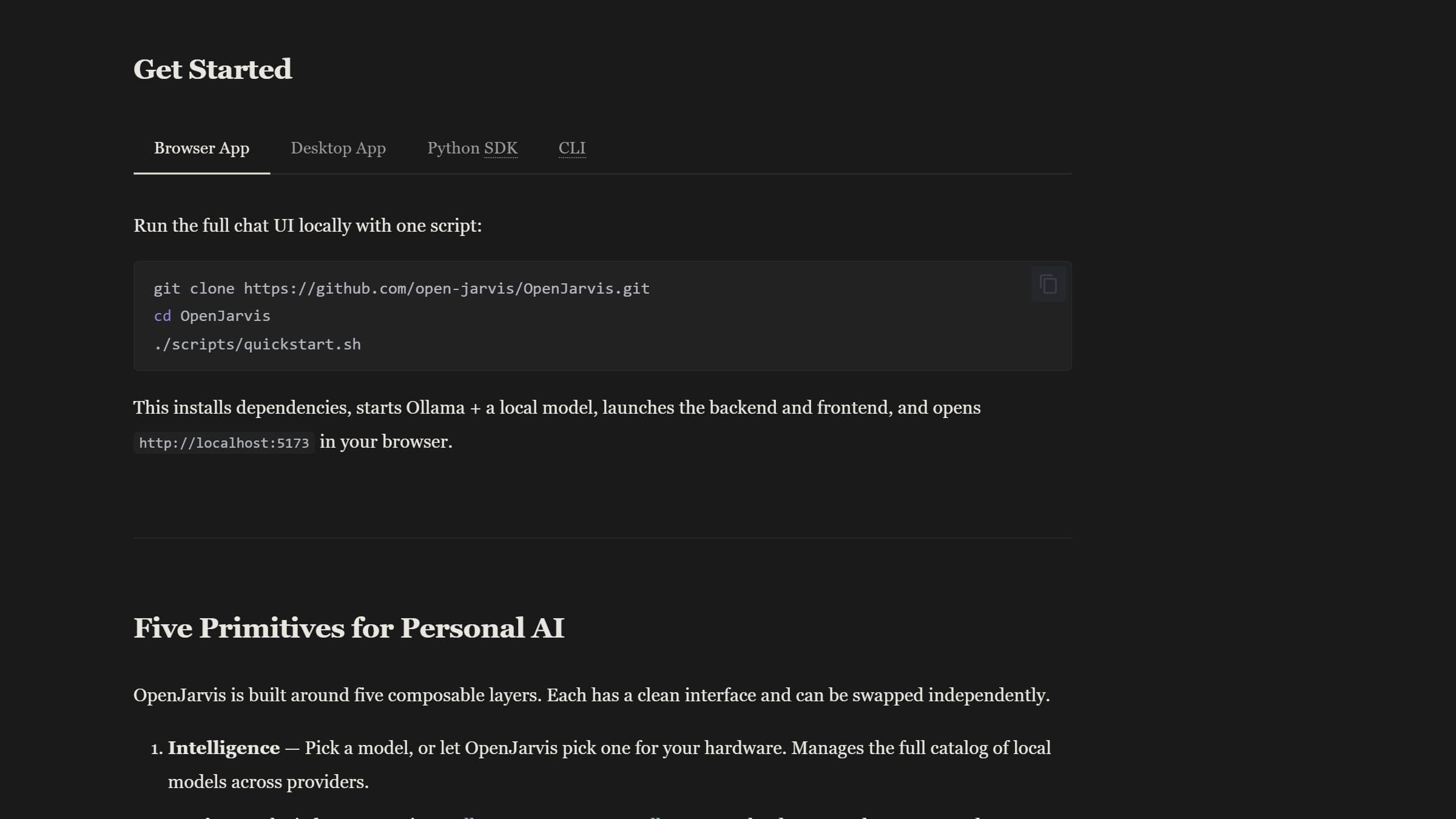
Beyond the desktop, there's a CLI, a Python SDK (the `Jarvis` class) and an API server on port 8000. It also integrates Google Drive, Gmail, Calendar and Tasks via OAuth, for agents that work with your own data.
Why it's good
What's interesting about OpenJarvis isn't one isolated trick, but the sum of parts:
- Real privacy: your conversations and files never leave the machine.
- Zero cost per token: the cloud is optional, not a monthly bill.
- Works offline: useful with no connection or with sensitive data.
- Measurable efficiency: energy and cost treated as metrics, not footnotes.
- Flexibility: multi-backend and an OpenAI-compatible API.
- Extensible: a large ecosystem of reusable skills.
- Open and academically backed: Apache 2.0 with Stanford science behind it.
Conclusion
OpenJarvis is the software layer that local AI hardware was missing. If the DGX Spark put the power on your desk, OpenJarvis puts the agents, memory and tools on top to actually use it without depending on a paid API.
If you care about privacy, cost, or simply want to experiment with real agents without exposing your data, it's well worth trying. It's also a clear signal of where personal AI is heading: back onto your own machine.
Ask this article
Eathan · Farid's AI, anchored to the text
Answers based only on this article.
Could this help your business?
Get a free AI diagnosis, tailored to your case in 60 seconds: what to automate, what stack and the first step.