
What the DGX Spark is
NVIDIA introduced the DGX Spark as the compact version of its DGX line, the same one powering the training clusters of the big labs. The difference is the form factor: instead of an 8U rack in a data center, the Spark sits on a desk and runs off a single power cable.
At its core is the GB10 Grace Blackwell Superchip, which packs into a single SoC a Blackwell GPU with 128 GB of unified LPDDR5X memory and a 20-core ARM Grace CPU. That unified memory is the technically interesting part: GPU and CPU share the same memory bank at 273 GB/s of bandwidth, removing the PCI transfer bottleneck that limits conventional setups.
In practice, that means you can run a 200-billion-parameter model in FP4 entirely in memory, with no aggressive quantization and no offloading to disk.
Why it matters for developers
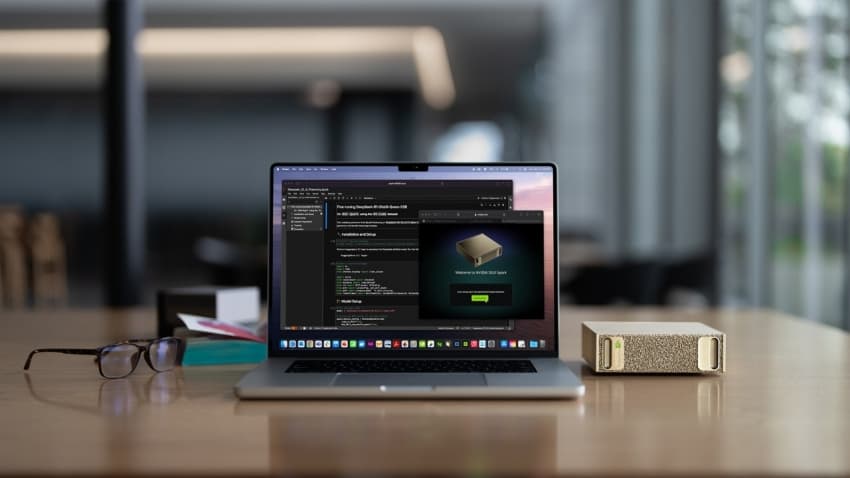
The full NVIDIA AI Enterprise ecosystem runs on the Spark. That includes NIM (NVIDIA Inference Microservices), the RAG stack with cuRVS, the RAPIDS acceleration libraries for Python, and native support for the main frameworks: PyTorch, JAX, TensorRT-LLM.
If you work with open-weight models like Llama 3.1 405B, Mistral Large, DeepSeek R1 or Qwen 2.5 72B, the Spark has enough memory to run them without dropping to 8-bit quantization. Models from 7B to 70B run with plenty of headroom, which lets you do batch inference or keep several models loaded at once.
One PFLOP of FP4 compute in a consumer device that fits under a monitor is a technical statement, not a marketing spec.
The software stack
The value proposition isn't only the hardware. NVIDIA ships the Spark with full access to its NIM microservices catalog, which includes pre-packaged models optimized for inference on Blackwell architectures. Initial setup is a graphical wizard that configures the system in under 10 minutes.
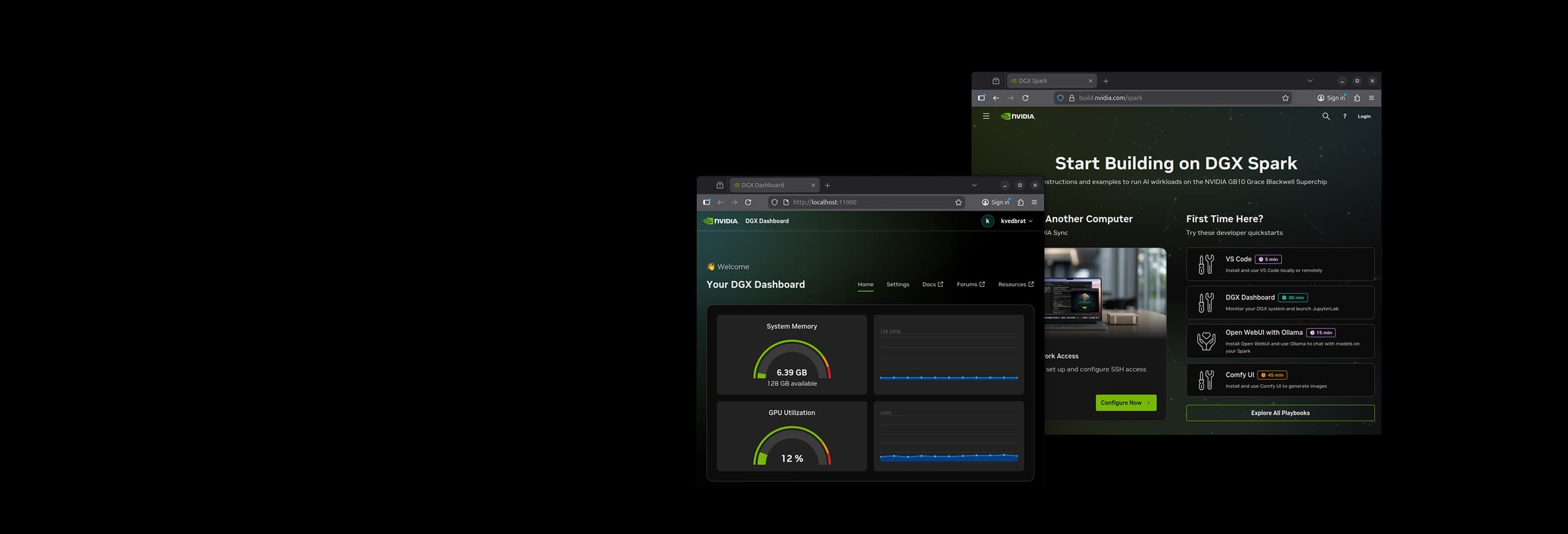
What comes preinstalled
- Ubuntu 22.04 LTS with CUDA 12.x drivers
- NVIDIA Container Runtime for Docker
- NVIDIA AI Workbench, the integrated development environment
- Direct access to the NGC catalog (NVIDIA GPU Cloud)
- Support for Ollama and LM Studio as lightweight alternatives
Interoperability
The Spark has two NVLink-C2C ports that let you pair it with another Spark to scale up to 256 GB of shared unified memory. It also connects directly to the DGX Station B200 for hybrid local + server pipelines without changing your application code, since both share the same CUDA-X stack.
Hardware and connectivity
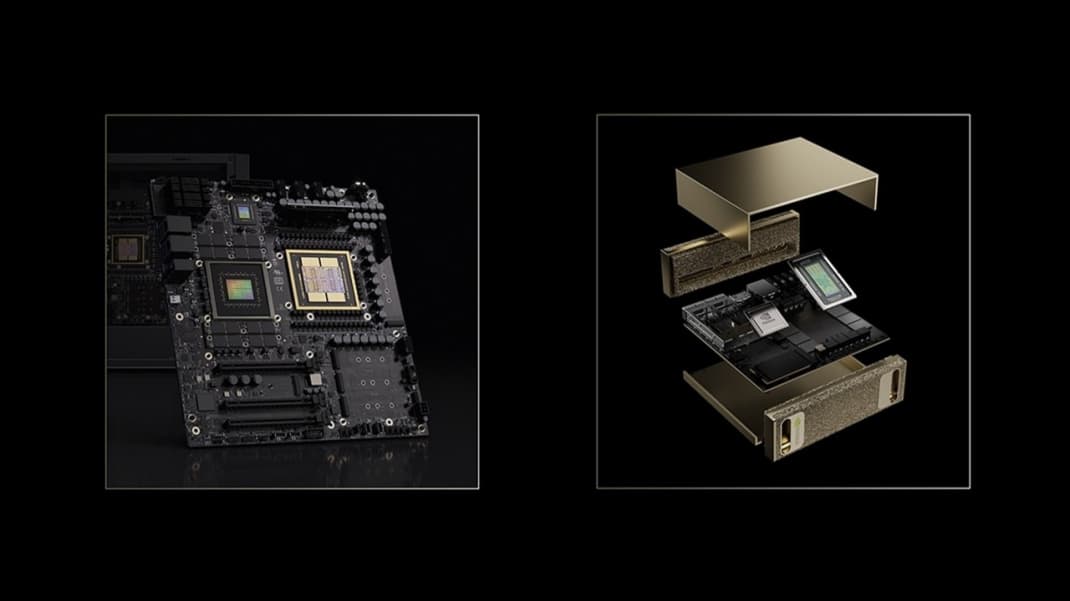
The chassis is compact and fully passive for the first 100W of load. Under sustained load it kicks in a low-noise internal cooling system. Ports include USB-C Thunderbolt 4, HDMI 2.1, 1GbE Ethernet, and the two proprietary NVLink ports for node-to-node expansion.
Compared to the alternatives
| Device | GPU memory | AI compute | Approx. price | AI stack |
|---|---|---|---|---|
| NVIDIA DGX Spark | 128 GB unified | 1 PFLOP FP4 | ~$3,000 USD | Full CUDA-X |
| Mac Studio M4 Ultra | 192 GB unified | ~400 TOPS | ~$4,000 USD | MLX / CoreML |
| PC with RTX 5080 | 16 GB GDDR7 | ~836 TOPS | ~$2,000 USD | Partial CUDA |
| PC with RTX 5090 | 32 GB GDDR7 | ~3,352 TOPS | ~$3,500 USD | Full CUDA |
| AWS p4d.24xlarge / hr | 320 GB HBM2e | 2.5 PFLOPS | ~$32 USD/hr | Full CUDA |
The comparison against cloud is where the Spark's economic argument gets clearest. At $32/hr on AWS, the breakeven against the Spark's price lands around 100 hours of GPU time. For any project of moderate intensity, that's a matter of weeks.
Conclusion
The DGX Spark is a niche product with a very clear niche: researchers, ML engineers and small teams that need serious local inference capacity without managing cloud infrastructure. For that profile, the offer is hard to ignore.
For a developer who already has a Windows workstation with an RTX 5080 or 5090 and uses Ollama for local inference, the Spark works better as a companion than as a replacement: it adds 128 GB of unified memory for large models while the workstation stays the main development machine.
What NVIDIA pulled off technically with the GB10 is real. One PFLOP of FP4 compute under 170W in a desktop form factor has no precedent. If the price comes down, or if your use case means running 100B+ models regularly, the argument gets a lot stronger.
Ask this article
Eathan · Farid's AI, anchored to the text
Answers based only on this article.
Could this help your business?
Get a free AI diagnosis, tailored to your case in 60 seconds: what to automate, what stack and the first step.