
What ISO/IEC 27001 is
ISO/IEC 27001 is the international information security standard. Published by ISO (the International Organization for Standardization) and the IEC, it defines how to set up and maintain an ISMS: an Information Security Management System. The current version is the 2022 one.
The key point is that it doesn't certify a specific product or technology. It certifies a way of managing: that the company identifies its information risks, decides which controls to apply, puts them in place and reviews them again and again. It's not «we have an antivirus»; it's «we have a method for knowing what to protect, how, and who responds».
Why certification matters
The most honest reason is trust. When a client —especially a big one, a bank or the government— is about to hand you their data, they need a verifiable guarantee that you'll take care of it. The certificate, issued by an independent third party, is that guarantee. It stops being «trust us» and becomes «an external auditor checked it».
- It opens commercial doors: many tenders and large contracts require it as an entry condition. Without it, they won't even let you compete.
- It reduces real risk: the process forces you to find the holes before an attacker does. Security genuinely improves, not just on paper.
- It puts the house in order: clear roles, written processes, tested backups. You stop depending on «hopefully someone remembers to do it».
- It eases compliance: it supports and complements data protection laws (like Law 1581 in Colombia or the GDPR in Europe).
How it's implemented, step by step
The heart of the standard is a continual improvement cycle known as PDCA (Plan, Do, Check, Act). It's not a project with an end; it's a wheel that keeps turning.
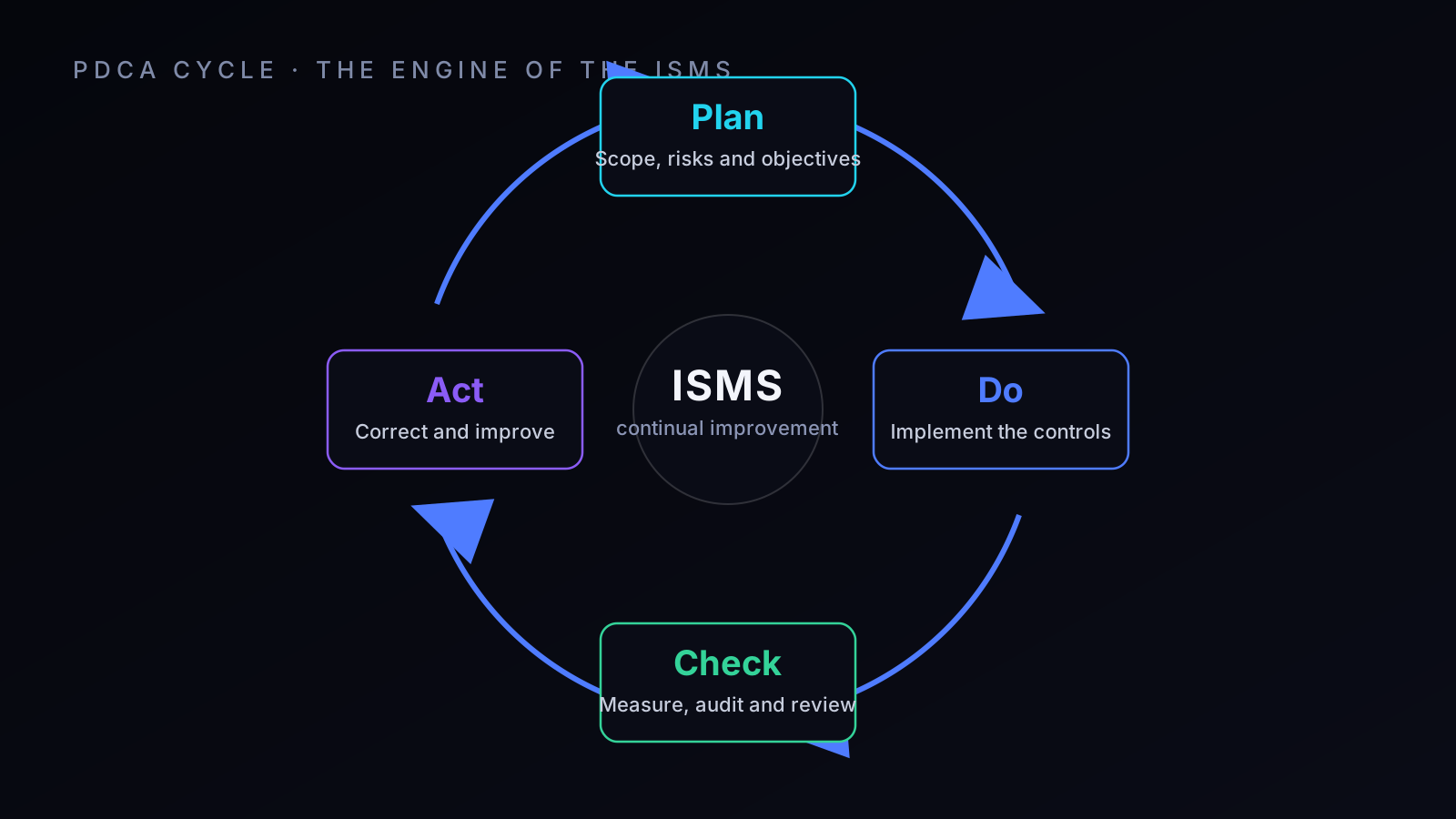
- Plan: define the scope (what's in and what's out), secure management's backing, run a risk assessment (what can fail and how much it hurts) and pick the controls to treat it.
- Do: implement those controls —technical and managerial—, write the policies and train the team.
- Check: measure whether they work, run internal audits and a management review.
- Act: fix what failed, close nonconformities and improve. Then the cycle restarts.
Certification comes when an accredited body audits the system in two stages (documentation review and on-site audit). The certificate lasts three years, with annual surveillance audits to confirm the wheel keeps turning.
The controls: Annex A
The standard ships a reference catalog —Annex A— which in the 2022 version is 93 controls grouped into four themes. You don't apply them all blindly: you pick the ones your risks justify, and document why in the «Statement of Applicability».
| Theme | What it covers |
|---|---|
| Organizational | Policies, roles, suppliers, incident handling (37 controls). |
| People | Awareness, responsibilities, remote work (8 controls). |
| Physical | Access, equipment, clear desks and screens (14 controls). |
| Technological | Encryption, backups, logging, access control (34 controls). |
Who already holds it (and what it gave them)
The giants that handle other people's data have held it for years. Amazon Web Services, Microsoft Azure, Google Cloud and IBM maintain their ISO/IEC 27001 certification —public information, verifiable on their compliance portals—. They don't do it for show: without it, a large share of their enterprise and government clients couldn't hire them.
And that's the lesson for a small or mid-sized company: the certificate a bank demands from AWS is the same one that can open a door for you with a big client. The standard doesn't distinguish by size —it distinguishes by method—.
How we're doing it at Xentris
At Xentris Tech we're in the process of implementing it. We don't claim to hold the certificate yet; we're building the ISMS with the same seriousness we build software: defining the scope, drawing up the inventory of information assets and prioritizing controls by the real risk of each project.
It hits close to home because we work with sensitive data: AutoSGSST processes occupational health and safety information for Colombian companies. There, security isn't decoration —it's the foundation of the service. That's why the team is strengthening its cybersecurity training to lead the implementation with judgment, not hearsay.
Conclusion
Getting ISO/IEC 27001 certified isn't paperwork: it's adopting a method to protect what matters most, the data. It gives clients confidence, opens commercial doors and puts the house in order. In the next two articles of this series we go deeper: why an AI company needs it even more, and the concrete roadmap —with timelines and costs— to achieve it.
Ask this article
Eathan · Farid's AI, anchored to the text
Answers based only on this article.
Could this help your business?
Get a free AI diagnosis, tailored to your case in 60 seconds: what to automate, what stack and the first step.