
Say hello to Bob 2.0
On August 12, 2026, IBM published a post with an almost affectionate title: *«Say hello to IBM Bob 2.0»*. Bob is IBM's AI software development partner, and version 2 isn't a patch: it rewrote the whole architecture. It's not a better autocomplete. It's an agent that takes a software goal and carries it from planning to code, to testing, to deployment and even to modernizing legacy systems.
The interesting part is who's saying it. IBM is the home of the mainframe, of COBOL, of the enterprise software that runs banks and insurers. That this player —the most conservative in the field— is going all in on agents says a lot about the moment. Bob 2.0 was tested with more than 100,000 IBM developers before release.
From copilot to development partner
For years, «AI for coding» meant autocomplete: a copilot suggesting the next line while you hold the wheel. Bob 2.0 changes the frame of reference. And its own product leader says so plainly.
The bar for enterprise AI is no longer a better coding assistant. It's an end-to-end agentic development partner. — Neel Sundaresan, GM of Automation and AI, IBM.
The difference is fundamental. A copilot suggests and you execute. A partner takes the goal, gathers the context of the whole repository on its own, decides the steps, runs the tools it needs and hands you the result to review. The human still leads: you decide, correct and approve. But the mechanical work stops being yours.
How it's built inside
Bob 2.0 rewrote its architecture into three cleanly separated layers. That's not a minor technical detail: it's what lets a single reasoning engine serve many interfaces without duplicating logic.
| Layer | What it does |
|---|---|
| The Agent | The central agentic loop: it reasons and generates the code. |
| The Harness | The shared infrastructure: authentication, logging and telemetry. |
| The Clients | The interfaces (IDE and others), with zero duplicated logic. |
On that base they layered concrete improvements: support for MCP (Model Context Protocol) servers to plug in external tools, a rollback that directly tracks file state, a cleaner UI that hides intermediate tool calls, and background multitasking that doesn't lock the session while it works.
Many agents at once
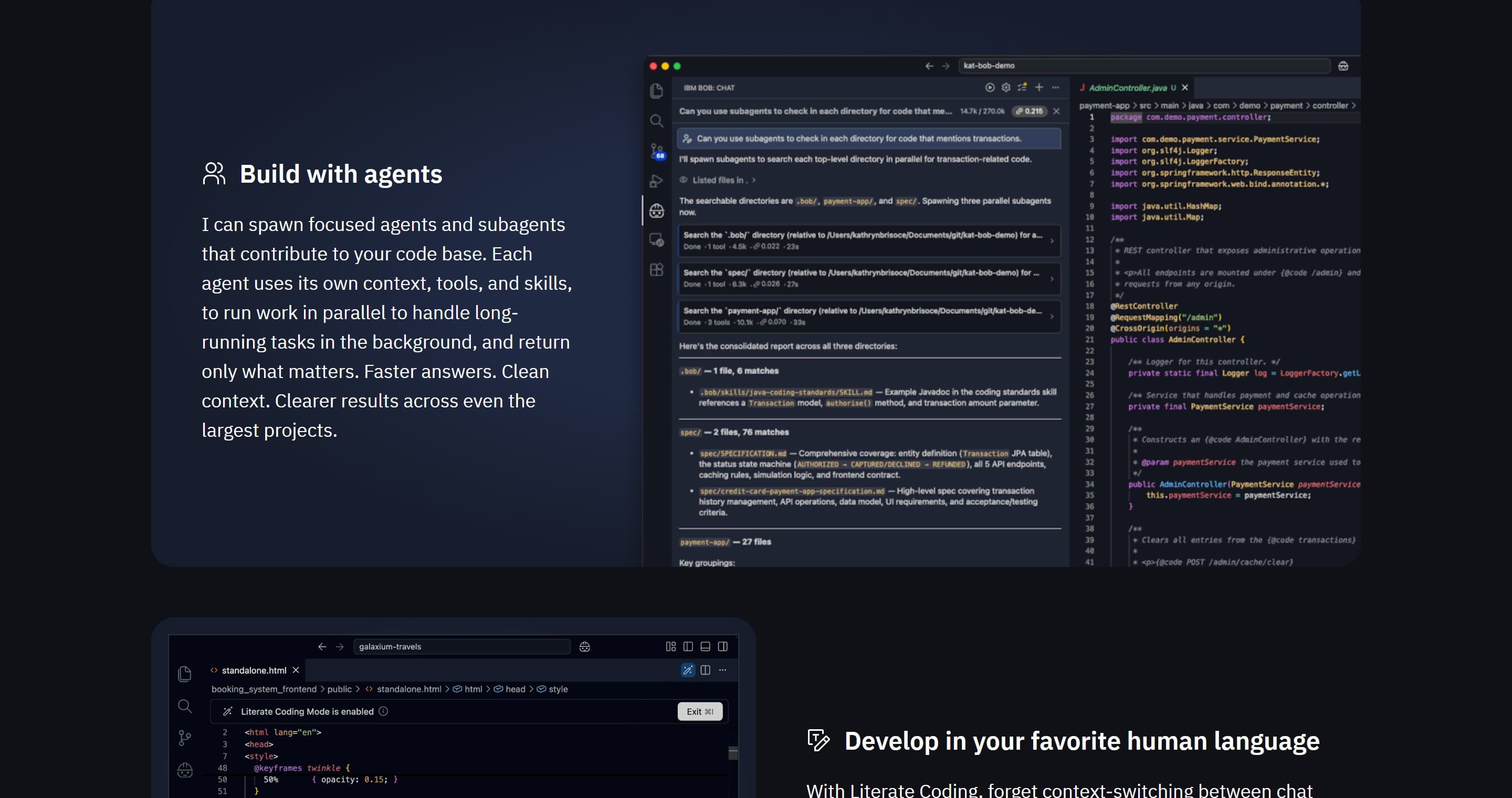
The biggest leap in version 2 is that Bob stopped being a single agent doing everything in one context. It now coordinates subagents working in isolated contexts. Instead of bloating a single context window —slow and expensive—, it delegates the complex work and keeps cost in check.
- Parallel tool calling: the model can request and run several tools in a single turn, not one at a time.
- Subagents in isolated contexts: each heavy task lives in its own space; less noise, less cost.
- Workflows: they give a «backbone» to repeatable processes —the engine runs the steps in order, holds state, handles errors and keeps it all auditable.
- Bobalytics: built-in analytics showing how much the AI consumes, where and at what cost.
Agent, Plan and Ask
Bob 2.0 has three modes to ask for things, depending on how much you want it to act:
- Ask: ask and understand the code without touching anything. Great for exploring someone else's repo.
- Plan: it lays out the steps before executing. You review and approve.
- Agent: it runs the work end to end, with whatever tools it needs.
Modernizing COBOL, IBM i and Java
This is where IBM's DNA shows. Alongside Bob 2.0 they shipped premium packages with specialized workflows for modernizing legacy systems —the hardest, and also the most valuable, work in the enterprise world.
| Package | What it's for |
|---|---|
| IBM Z | COBOL, PL/I and JCL analysis on the mainframe. |
| IBM i | Remote file system and IBM i-specific tooling. |
| Java | Migration to Java 25 and large-scale refactoring. |
That's the exact point: moving thirty-year-old code that runs a bank is precisely the kind of task a well-governed agent is for. It's not creative magic; it's judgment applied at scale, with every step traceable.
Why it's built for enterprises
Bob 2.0's differentiator isn't only what it can do, it's the guardrails. Governance, security and cost control embedded at every step; auditable workflows; and Bobalytics so a team sees what the AI consumes. It's the answer to the question that holds big companies back: «how do I let an agent touch my code without losing control?».
The details tell the same story: it was tested with over 100,000 internal developers, existing settings migrate automatically and the only step to upgrade is installing it. IBM isn't running an experiment; it's standardizing a way of working.
What I see from here
Bob 2.0 confirms something I keep repeating on this blog: software is shifting from tool to agent. You stop opening a screen to do the work yourself; you hand over a goal and the agent executes it. What's remarkable isn't the idea —it's who's signing it. When IBM, the most enterprise player there is, sets it as the standard, it stops being a trend and becomes the floor.
And there's a detail that hits close to home: that Agent / Harness / Clients split is exactly how the agents I work with every day are built. The same principle scales from my automation projects —AutoSGSST reading a photo and writing a legal OSH report— all the way to modernizing a mainframe. The size changes, not the idea.
For Colombia and Latin America the lesson is liberating: you don't have to be IBM to apply this. An agent that reads documents, decides the steps and delivers the result is within reach of a local team. That is, exactly, the bet we're making at Xentris Tech.
Conclusion
Bob 2.0 isn't news just because IBM shipped a tool. It's a signal: the industry standard is no longer «a better assistant», but «an agentic partner». Whoever starts automating with agents today —reading documents, deciding steps and delivering— is on the right side of the shift. Bob is the enterprise version of an idea that already fits in a local project.
Ask this article
Eathan · Farid's AI, anchored to the text
Answers based only on this article.
Could this help your business?
Get a free AI diagnosis, tailored to your case in 60 seconds: what to automate, what stack and the first step.