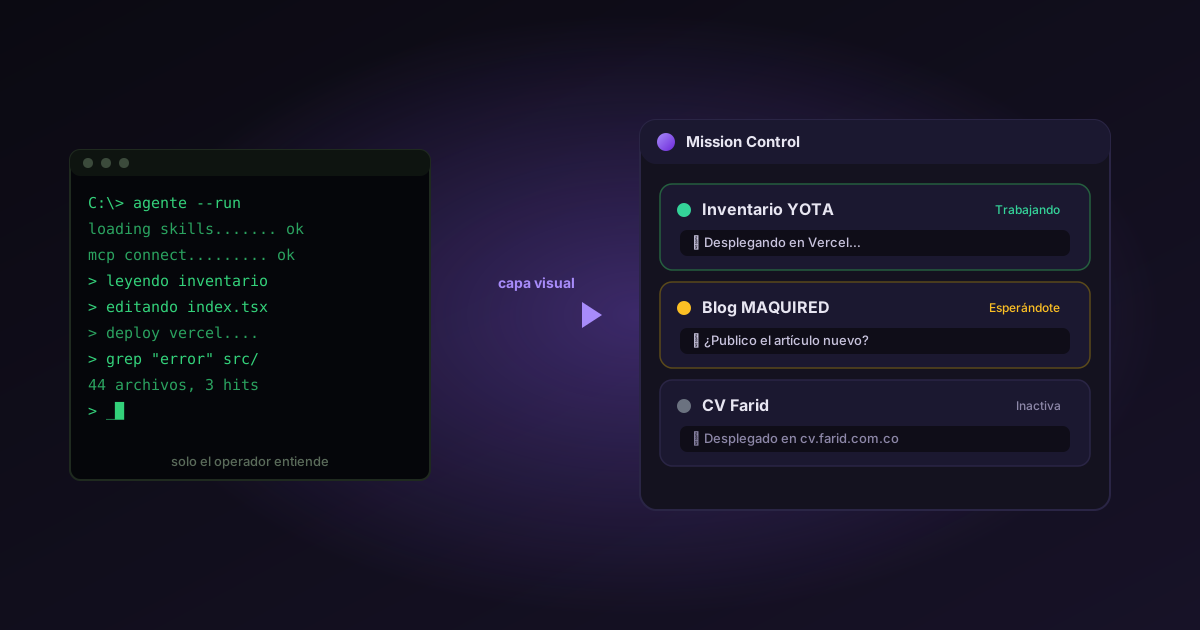
The terminal came back, and almost nobody noticed
A friend asked me the other day if I remembered WordStar and Visual Basic. WordStar was the 1980s word processor you drove with key chords; Visual Basic, the one that let you build an application by dragging buttons. Pure nostalgia — until he dropped the line that stuck with me: «you're like that, but with AI; MCP is like an API… why isn't there an operating system, like when Windows came out?».
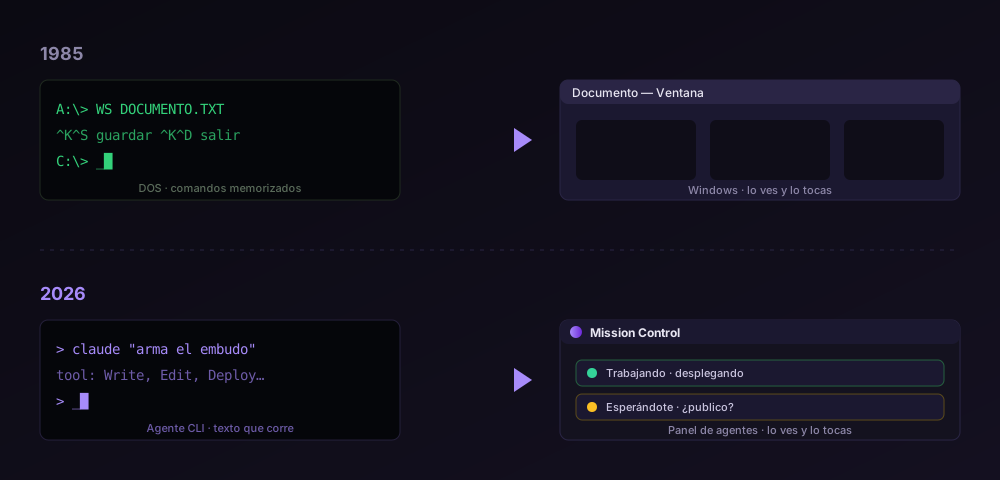
He was onto something deep. After years of graphical interfaces, the most advanced software of 2026 —AI agents— is once again driven by typing into a terminal. The oldest interface in computing became the newest again. And with it came back an old problem we had already solved once.
Why an agent today resembles MS-DOS
A modern agent already has almost everything that defines an operating system. It's not an exaggeration — it's literal.
- Memory that persists across sessions.
- A file system it reads from and writes to.
- «Programs» that extend what it can do (skills).
- Scheduled tasks that run on their own.
- A connection to services through a standard —MCP—, which plays the role Windows APIs once played: a common plug to talk to any tool.
What it still lacks to be a true operating system is three concrete things: determinism (an OS can't «sort of» save your file; an agent is still probabilistic), cost and latency (every action costs money and takes seconds, not milliseconds) and trust (that's why we work with permissions and controlled environments, rightly so). At first, Windows didn't do more than DOS either. It won for another reason.
The problem almost nobody names: observability
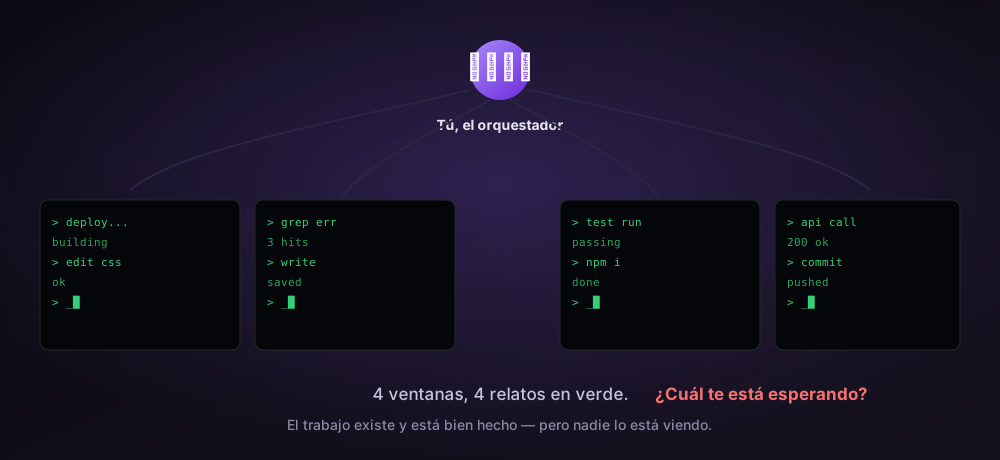
When you coordinate several agents at once —as I do almost every day— a very concrete pain shows up. With five tasks running, you lose track of which one is doing what. And when you show the screen to a client, they see technical text scrolling in green instead of understandable work.
That has a name: observability. The good news is the information already exists —every agent records everything it does in real time—; what's missing is a layer that translates it into human language. Nobody is watching it, but it's there.
The solution is visual: the «Windows» of agents
Windows didn't win because it did more than DOS. It won because anyone could see what was happening. The next big AI layer is exactly that: a dashboard that shows, for each agent, what it's doing right now, in one clear sentence. A good dashboard answers three questions at a glance:
- What is each agent doing right now, in plain language?
- Which one finished and is waiting for a decision from me?
- Which one is stuck or needs a permission?
Asimov, and why a dashboard is governance
In 1950, Isaac Asimov published his Three Laws of Robotics. The interesting part is that his book isn't a manual: it's a catalog of how those rules fail. Three simple rules, applied literally, end up producing absurd results. The lesson, 75 years later, still holds: a handful of rigid rules isn't enough to govern a complex intelligence; there are always gaps, and intelligence finds them.
That's why responsible AI isn't based on three rules, but on layers: good baseline values, scoped permissions, controlled environments and —the final layer— human supervision. An observability dashboard is, quite simply, that supervision made visible.
What I see from here
This connects directly to what I already wrote about agent orchestrators: if a director splits the work among several agents, someone has to be able to see what each one is doing. The visual layer isn't decoration; it's what makes orchestration supervisable, explainable to the client and trustworthy. At Xentris Tech we treat it as a best practice: before scaling an AI automation, you make sure you can see and tell what it does.
For Colombia and Latin America the lesson is the usual one on this blog: you don't have to be a big tech company to apply it. I built the dashboard I'm describing in one afternoon, on my own machine, reading files that were already there. The opportunity is exactly in that gap: the agents that run in the terminal already work; the «Windows» that makes them understandable to any human is still to be built.
Conclusion
WordStar was memorizing chords; Visual Basic was dragging buttons; and today we came back to the terminal, but chatting in plain language. The oldest interface turned out to be the newest. We're in a 1985 moment: the «DOS» of AI —the agents— already exists and works. The «Windows» —the layer that lets you see the work— is vacant. And whoever builds it well, even on their own machine on a Tuesday afternoon, is a step ahead.
Ask this article
Eathan · Farid's AI, anchored to the text
Answers based only on this article.
Could this help your business?
Get a free AI diagnosis, tailored to your case in 60 seconds: what to automate, what stack and the first step.