What changed in software
For fifteen years, building software meant roughly the same thing: design an app, put it on a smartphone and wait for the person to open it, tap buttons and fill out forms. The app was the product, but the work was still yours: you captured the data, you wrote the text, you assembled the document.
Artificial intelligence changed the equation. Today software can do the work, not just show you where to do it. Instead of opening a screen and filling fields, you hand it evidence (a photo, a conversation, a document) and get the finished result back. The app stops being the destination and becomes the door to an agent that carries out the task for you.
What makes an agent different
An AI agent is not a chatbot that answers questions. It is a system that takes a goal, gathers the context it needs, decides the steps and produces a deliverable. It can read a PDF, look at an image, check a regulation, transcribe an audio clip and, with all of that, write a coherent report.
The difference with a traditional app is who carries the heavy lifting:
- Classic app: you understand the problem, you write; the app only stores and organizes.
- Agent: you hand over the evidence; the agent understands, writes and organizes; you review and approve.
- The human doesn't disappear: they decide, correct and sign off. The agent removes the mechanical work, not the expert judgment.
Reading documents, seeing images
Two capabilities made this leap possible. The first is that models now read documents the way a person would: they understand a contract, a regulation or an inspection sheet and extract what matters, with no rigid templates. The second is computer vision: the model looks at a photo and recognizes what's in it.
Put the two together and you get an assistant that takes reality as it is (a photo shot on a phone, a spoken interview, a messy file) and turns it into structured information. You no longer need to translate the world into a form: the agent does it for you.
From data to PDF, no typing
The final link is the output. An agent doesn't finish its work on a screen: it generates the document. It takes the information it interpreted and pours it into a report with the structure the business or the law requires, ready to download as Word, Excel, PDF or even audio.
That is the flow that defines this new generation of applications: free input (photo, voice, document) → AI interpretation → formal deliverable. The person goes from typist to supervisor.
The AutoSGSST case
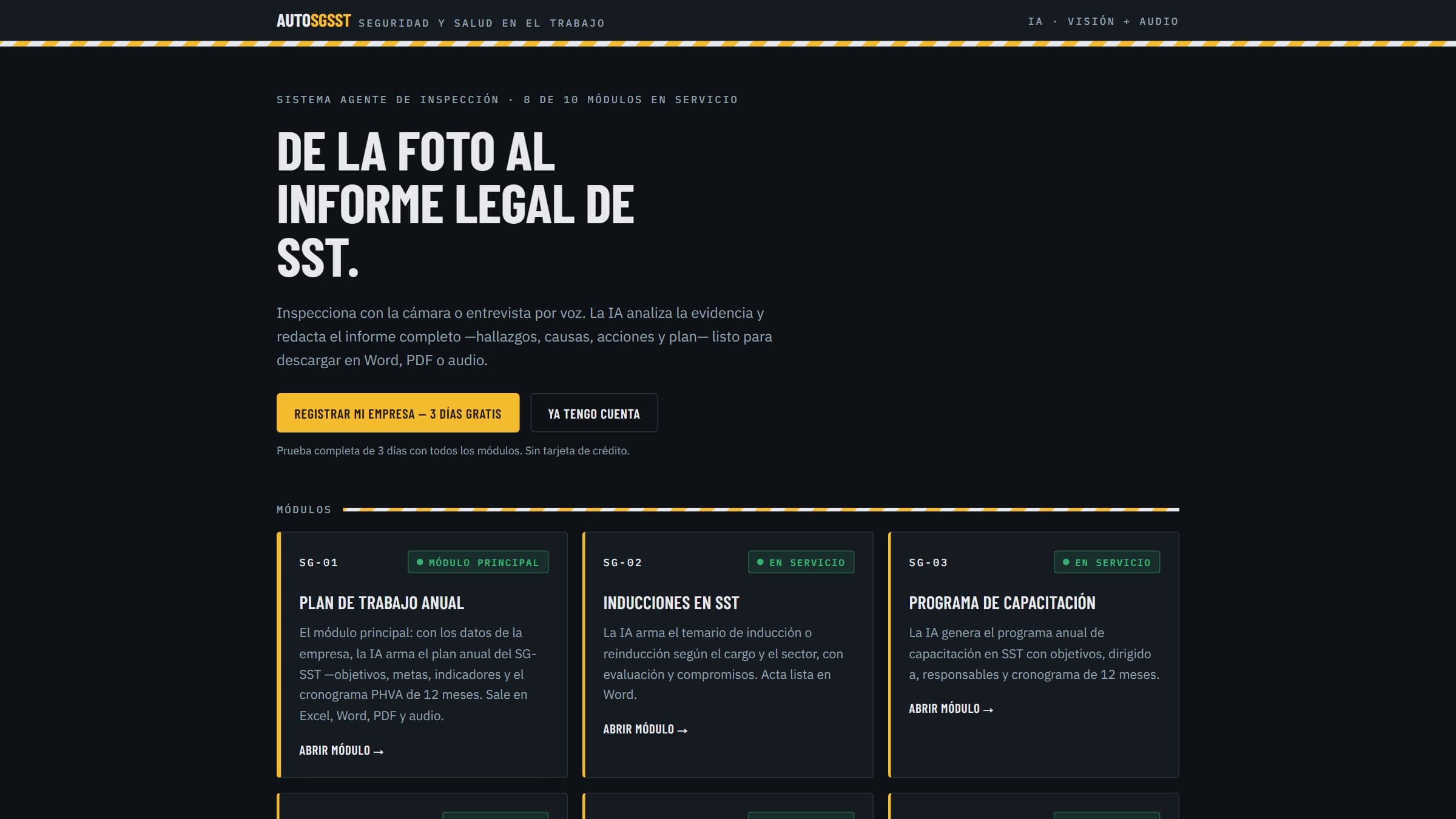
AutoSGSST (autosgsst.vercel.app) is a real, in-production example of all of the above applied to a very concrete pain: SG-SST, the occupational safety and health management system that Colombian law requires of every company. Documenting it by hand is slow, repetitive and easy to leave incomplete.
The promise is direct: from the photo to the legal report. You inspect with the camera or run a voice interview, the AI analyzes the evidence and writes the full report (findings, causes, actions and plan) ready to download as Word, PDF or audio. It's not a faster form: it's the finished document.
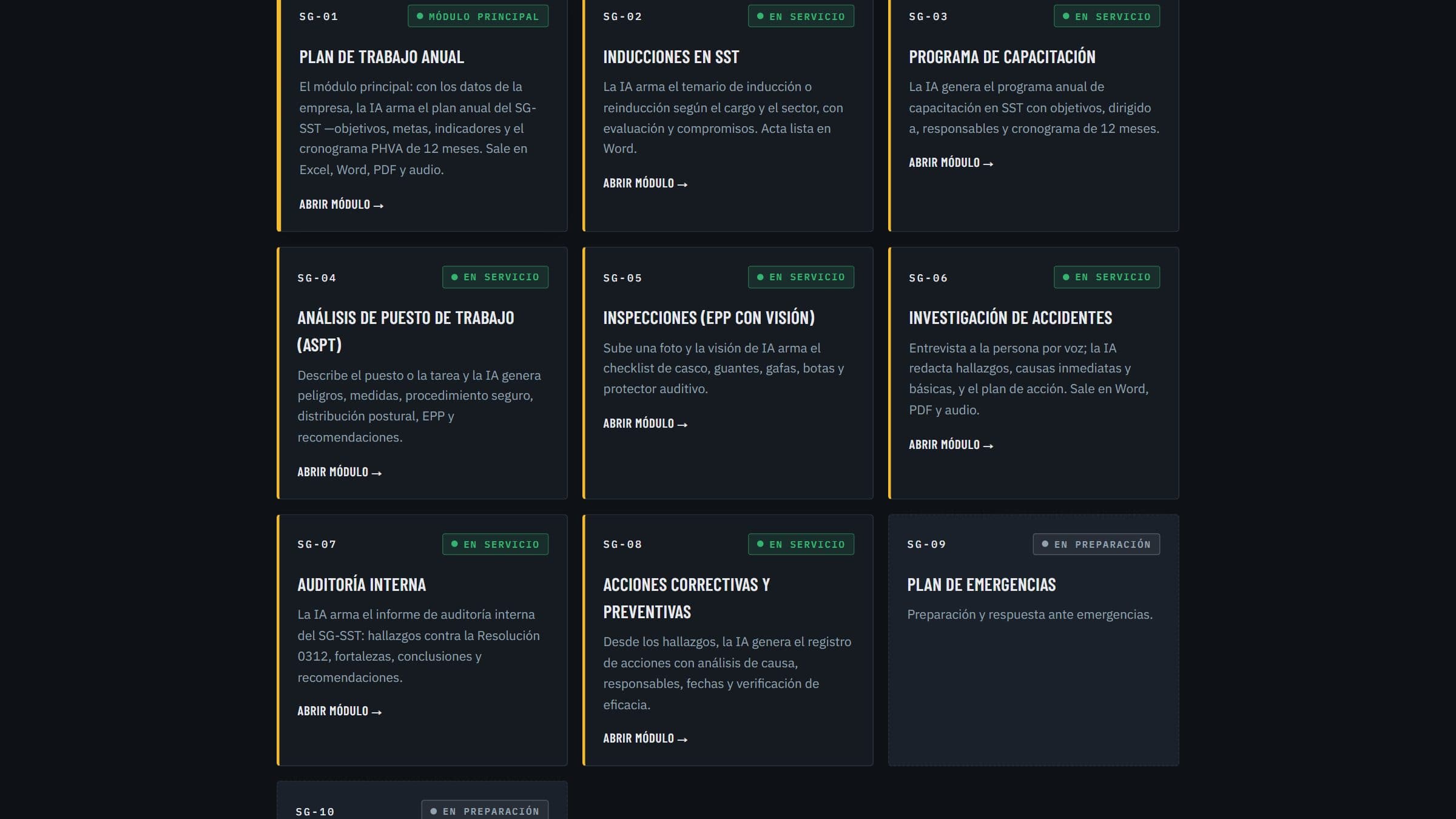
It currently has 8 of 10 modules in service, and each one is a specialized agent:
| Module | What the agent does |
|---|---|
| Annual work plan | Builds the SG-SST plan with objectives, targets, indicators and a 12-month PDCA schedule. |
| Safety inductions | Generates the syllabus by role and sector, with assessment and commitments. |
| Training program | Annual program with objectives, owners and schedule. |
| Job hazard analysis | You describe the task and it returns hazards, controls, PPE and safe procedure. |
| PPE inspections | You upload a photo and vision builds the checklist: helmet, gloves, goggles, boots, ear protection. |
| Accident investigation | Voice interview; it writes findings, causes and action plan. |
| Internal audit | Report against Resolution 0312, with strengths and recommendations. |
| Corrective actions | From the findings, it generates the log with cause, owners, dates and verification. |
How Xentris got into automation
Here's the part I find most interesting as an engineer. Technology alone doesn't make a good compliance product: you need to know what a legal report must say for it to hold up in an audit. That's why AutoSGSST wasn't born in a technical vacuum.
Xentris Tech (xentris.tech) built the platform together with Rafael Soto (rafael.xentris.tech), an HSEQ consultant with 20+ years in occupational safety across energy, oil & gas and industry. It's the model that works: human domain expertise + AI agents. The AI was trained on Colombian safety legislation and on the judgment of someone who has lived audits from the inside.
It's not just another safety software. It's an intelligent system.
That's the difference between digitizing a form and automating judgment. Xentris took a consultant's knowledge and turned it into an agent that answers, writes and documents the way he would, available 24/7.
A value proposition for Colombia
In Colombia, SG-SST isn't optional. Decree 1072 of 2015 and Resolution 0312 of 2019 require companies, regardless of size, to implement and document their safety system, and to sustain it for audits, the RUC or certifications like ISO 45001. For thousands of small businesses, that means hiring expensive consulting or staying exposed to penalties.
AutoSGSST's value proposition is to close that gap: put an expert consultant's judgment within reach of any company, at the cost of software rather than hours of advice. It's technology built from and for the Colombian context, not an imported template.
Why this matters
Beyond SG-SST, AutoSGSST is a glimpse of where useful software is headed:
- Tedious work gets delegated. Writing, organizing and formatting stop eating human hours.
- Expert knowledge scales. One consultant no longer serves ten companies; their judgment, turned into an agent, serves a thousand.
- Input becomes natural. A photo or a conversation replaces endless forms.
- The deliverable is formal. What comes out is a legal document, not a screen you still have to write up.
- The human levels up. They go from filling fields to deciding and approving.
That pattern (free evidence, an agent that interprets, a finished document) can be carried to contracts, health, accounting, legal or logistics. AutoSGSST is proof that it already works in production, on a real, regulated need.
Conclusion
The era of the app on a smartphone isn't over, but it's no longer the ceiling. What comes next are agents that read, see and write: software that does the work and leaves you the judgment. AutoSGSST proves it in a field where mistakes are costly, and it does so from Colombia, pairing a consultant's experience with the power of AI.
If you want to see it working, go to autosgsst.vercel.app and try the full flow. And if there's a process in your company that's still done by hand (reading, interpreting, documenting), it's probably already automatable. That's what this moment is about.
Ask this article
Eathan · Farid's AI, anchored to the text
Answers based only on this article.
Could this help your business?
Get a free AI diagnosis, tailored to your case in 60 seconds: what to automate, what stack and the first step.