
What a quantum computer is
A regular computer processes bits: each one is a 0 or a 1. A quantum computer uses qubits, which thanks to superposition can represent 0 and 1 at the same time, and through entanglement correlate in ways impossible for a classical bit. The practical effect is that the computing space grows exponentially with every qubit you add.
The catch is that qubits are fragile: they lose their state at the slightest noise (decoherence). Keeping them stable and correcting their errors is the great challenge of quantum engineering, and that is exactly where IBM is betting hard.
What IBM built: interacting with a real one
Here's what you probably had in mind. On May 4, 2016, IBM put the first quantum computer on the cloud: for the first time, anyone in the world could run programs on a real 5-qubit quantum machine from their browser, without owning one. That service is called IBM Quantum Platform (formerly IBM Quantum Experience).
Access is handled with Qiskit, IBM's open-source development kit, in Python. In just a few lines of code you write a quantum circuit, send it to a real processor and get the results back. In 2026 that service turned ten years old, democratizing quantum computing.
Where IBM stands today
In 2026, every IBM quantum computer exceeds 100 qubits. The Heron r3 processor reaches 156 qubits with error rates around 1.17×10⁻³, and IBM runs the world's largest fleet of 100+ qubit machines (it has even demonstrated chips of up to 1,121 qubits).
In November 2025, at its developer conference, IBM unveiled two new processors that mark the next leap:
| Processor | What it brings |
|---|---|
| Nighthawk (120 qubits) | 218 tunable couplers and circuits ~30% more complex; scaling from 5,000 gates today to 15,000 by 2028. |
| Loon (~112 qubits) | First chip with every building block for error correction: long-range couplers, 3D wiring and fast qubit reset. |
The software improved too: Qiskit now runs dynamic circuits with 24% more accuracy at the 100+ qubit scale, exposes a C-API to integrate with classical supercomputing, and cut error mitigation cost by more than 100 times. It also achieved a real-time error decoder under 480 nanoseconds, roughly 10 times faster than the competition.
The roadmap to 2029
Something rare in this field: IBM publishes a plan with dates and concrete hardware.
- 2026: demonstrate community-verified quantum advantage, with an open Quantum Advantage Tracker.
- 2028: build Starling, a modular, error-corrected quantum supercomputer.
- 2029: Starling available and fault-tolerant, with about 200 logical qubits able to run 100 million gates, from a new quantum data center in Poughkeepsie, New York.
How you can try it yourself
The best part: you don't need a PhD or a lab to start.
- Create a free account on IBM Quantum Platform.
- Install Qiskit (a single `pip install qiskit`) or use the web editor.
- Write a two-qubit circuit, send it to a real machine and compare it against the simulator.
- Learn from scratch with IBM's free courses, like the Qiskit Global Summer School.
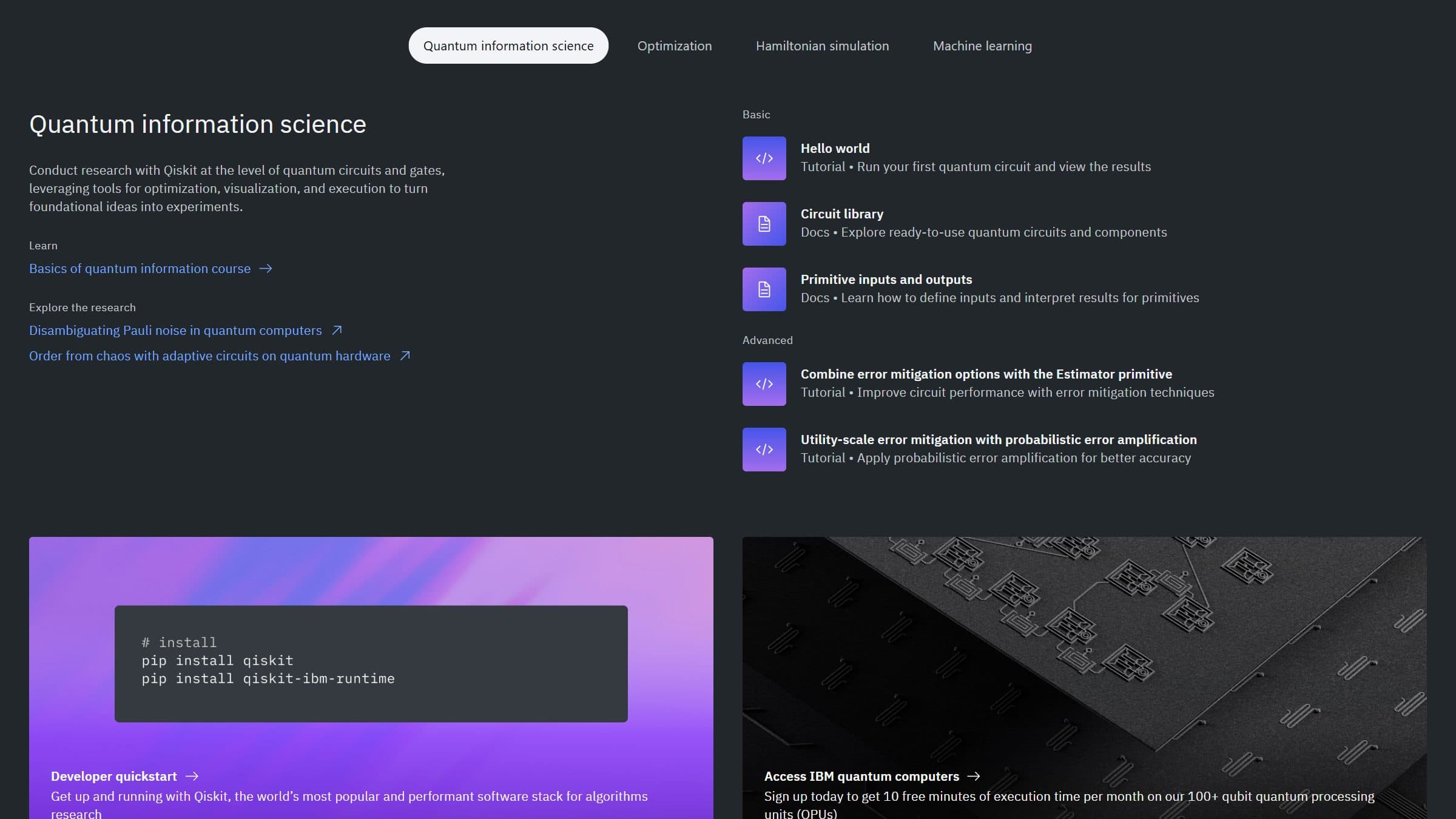
Programming a real quantum computer today fits in a few lines of code and a free account. That was science fiction ten years ago.
Why this is huge
Beyond the hype, this is what makes IBM's approach special:
- Real, open access: physical quantum hardware for anyone, free to start.
- A delivered roadmap: dates and real processors, not just promises.
- A mature ecosystem: Qiskit, documentation, courses and a decade-old community.
- Transparency: quantum advantage verified by the community, not by marketing.
- It adds to classical: quantum-centric computing that works with supercomputing, not against it.
Conclusion
Quantum computing has stopped being lab-only science fiction: today you can touch a real quantum computer from your browser, for free, in about ten minutes. That, at its core, is what IBM built and has spent a decade refining.
And if 2029 lands as planned, with a fault-tolerant Starling, we'll move from "experimenting" to "solving problems that are impossible today". It's worth learning to program quantum now, while the field is still young and there's room to truly understand it.
Ask this article
Eathan · Farid's AI, anchored to the text
Answers based only on this article.
Could this help your business?
Get a free AI diagnosis, tailored to your case in 60 seconds: what to automate, what stack and the first step.